
Coils of the Deep: The Reef’s Natural Barbed Wire
Written by Bennath Chillingworth
Have you ever been on a dive and noticed these strange barbed wire-like structures protruding from the reef… then forgotten to look them up afterwards?

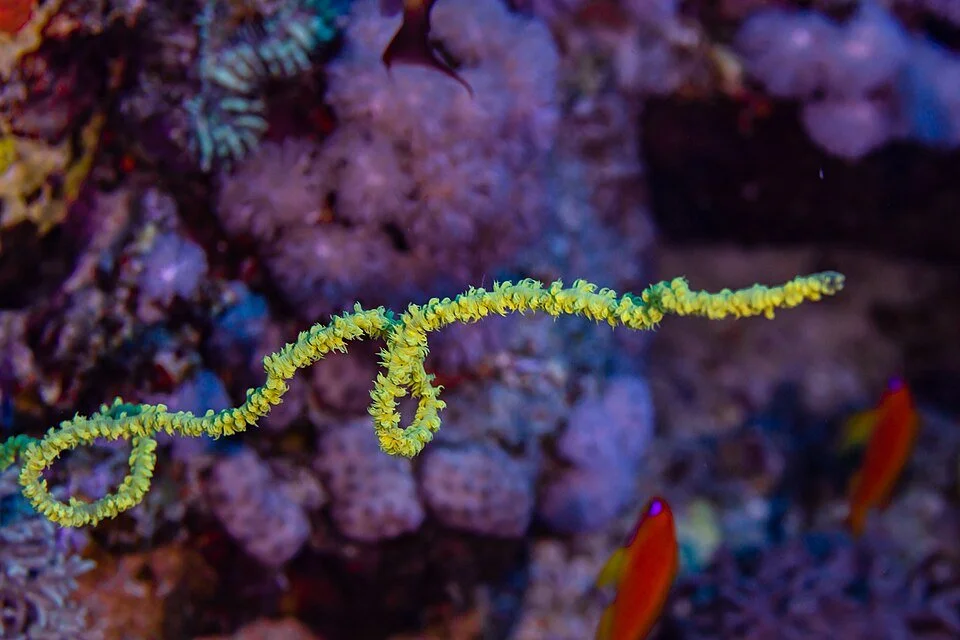
Cirrhipathes sp.
Image source: https://commons.wikimedia.org/wiki/File:Cirrhipathes_sp_-_coral-wire-groovy.jpg
Those are wire corals, also known as whip or corkscrew corals.
They’re a type of black coral, belonging to the order Antipatharia within the class Hexacorallia. Put simply, although they resemble soft corals with their flexible, almost rubbery skeletons that sway in the current, they’re actually more closely related to the ‘hard’, ‘stony’, or ‘reef-building’ corals that most people are familiar with. These are the corals that lay down a rigid calcium carbonate skeleton and form the structural foundation of the reef.
Black corals, however, do things differently. Instead of calcium carbonate, their skeletons are made of chitin (the same material found in crustacean shells!). Taxonomy is really never simple, is it?
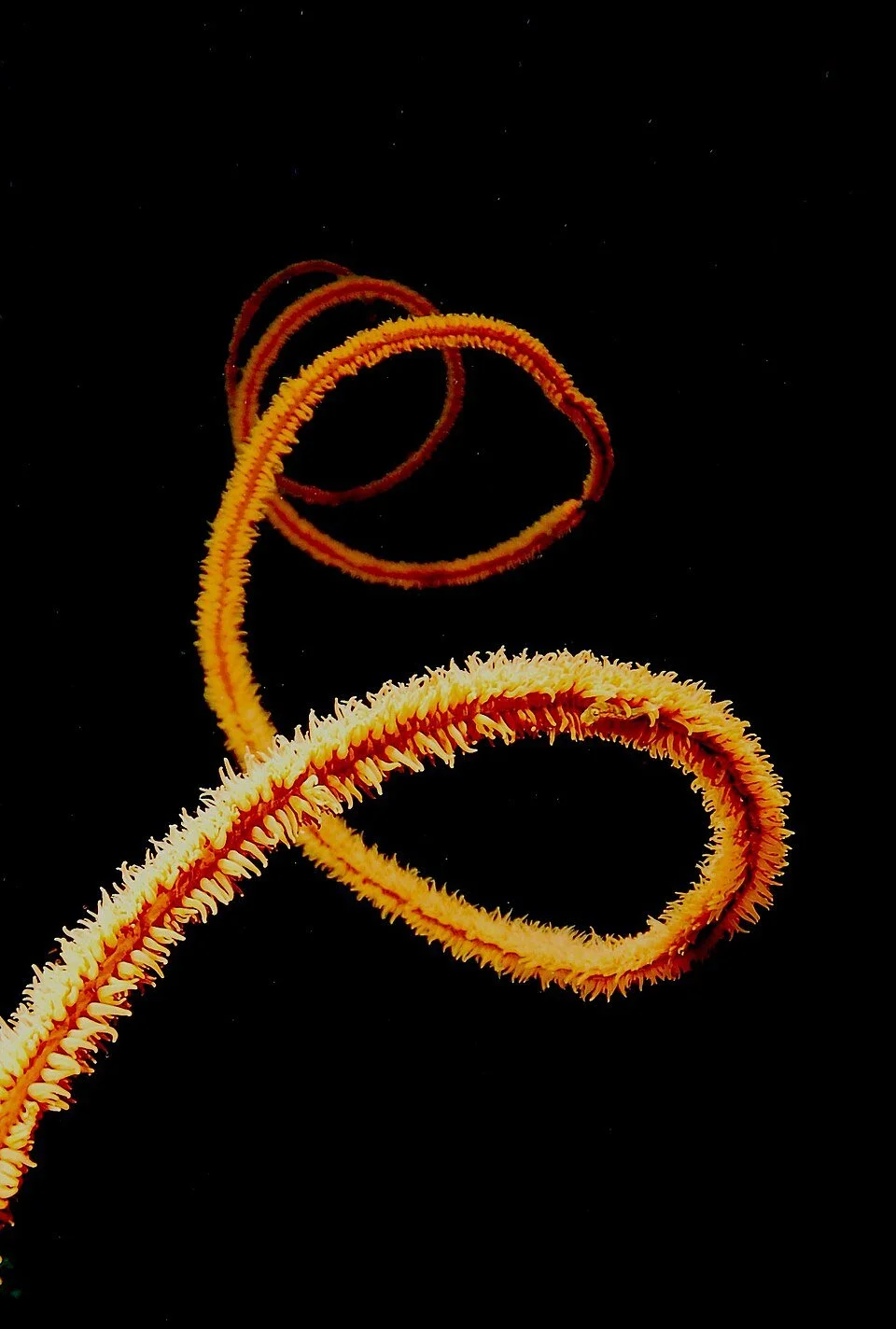
Cirrhipathes spiralis
Image source: https://species.wikimedia.org/wiki/Cirrhipathes_spiralis
What is simple is how they get their name. Their skeleton is black…hence the term “black coral”. Like other corals, they come in a variety of forms, including branched and unbranched species. Whip corals fall into the latter group, characterised by a single stem anchored to the reef at its base and extending out towards the blue.
Their dark skeleton is covered in brightly coloured polyps (the living part of the coral), ranging from yellows and reds to blues and greens. Each polyp is surrounded by thorn-like tentacles, giving it an almost prickly appearance.
Genera such as Cirrhipathes and Stichopathes exhibit a coiled or spiralling shape, while the more recently characterised genera Pseudocirrhipathes tends to be straighter, with a slight coil near the tip. This unusual twisting morphology is a result of the polyps’ inability to fully retract into its skeleton, and the flexibility of the skeleton itself, which allows it to bend!
Cirrhipathes sp.
Image source: https://fr.wikipedia.org/wiki/Cirrhipathes
Another interesting fact about black corals is that they were once thought to be completely azooxanthellate, meaning they lack the symbiotic algae (zooxanthellae) that most corals depend on for energy. While we now know that they can host these photosynthetic friends, the relationship is far less important to their nutrition than it is for other corals.
Instead, whip corals primarily feed on tiny animals that drift in the water known as zooplankton. They capture this zooplankton with their mucus and stinging cells, which is why they’re often found in areas with strong currents that bring a steady supply of food.
Their limited reliance on zooxanthellae also explains why they are typically found in deeper waters than most other corals, where light levels are low. Although some can occur as shallow as 15m, most are found below 50m, and their abundance typically increases with depth. This is likely to avoid competition with other light-dependent species, but makes them difficult to study. Therefore, much about their biology remains a mystery.
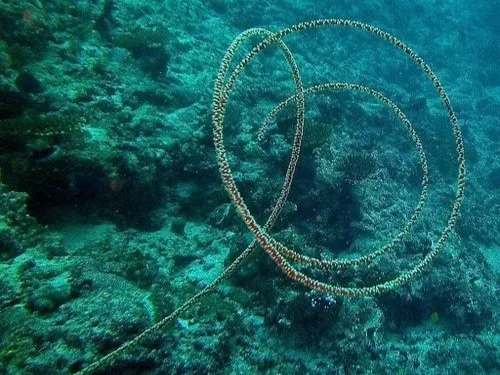
Cirrhipathes sp.
Photography by: Lesley Clements
What we do know is that whip corals play important ecological roles. By contributing to the three-dimensional structure of an otherwise flat seabed or steep reef wall, they help reefs absorb wave energy and create additional habitat space for a wide range of organisms. Some of these even depend on whip corals entirely for their survival.
One of the best examples is the whip coral goby (Bryaninops yongei). This tiny fish blends seamlessly into the coral stem with its transparent body, marked by reddish-brown vertical bars.
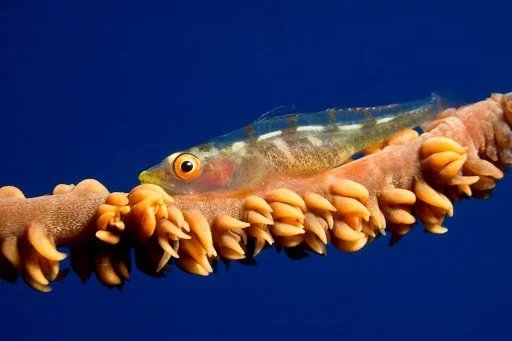
Bryaninops yongei
Image source: https://www.inaturalist.org/guide_taxa/2606670
The whip coral goby is perfectly adapted to life on a whip coral. Its pelvic fins act like tiny suckers, helping it cling to the coral even in strong currents. Its gills are positioned low on the body, making movement less visible to predators, and its large eyes help it spot passing food.
Shorter corals tend to host a single juvenile, while longer ones often support a pair of adults. These observations suggest a degree of territorial behaviour, with rarely more than two individuals ever occupying the same coral!
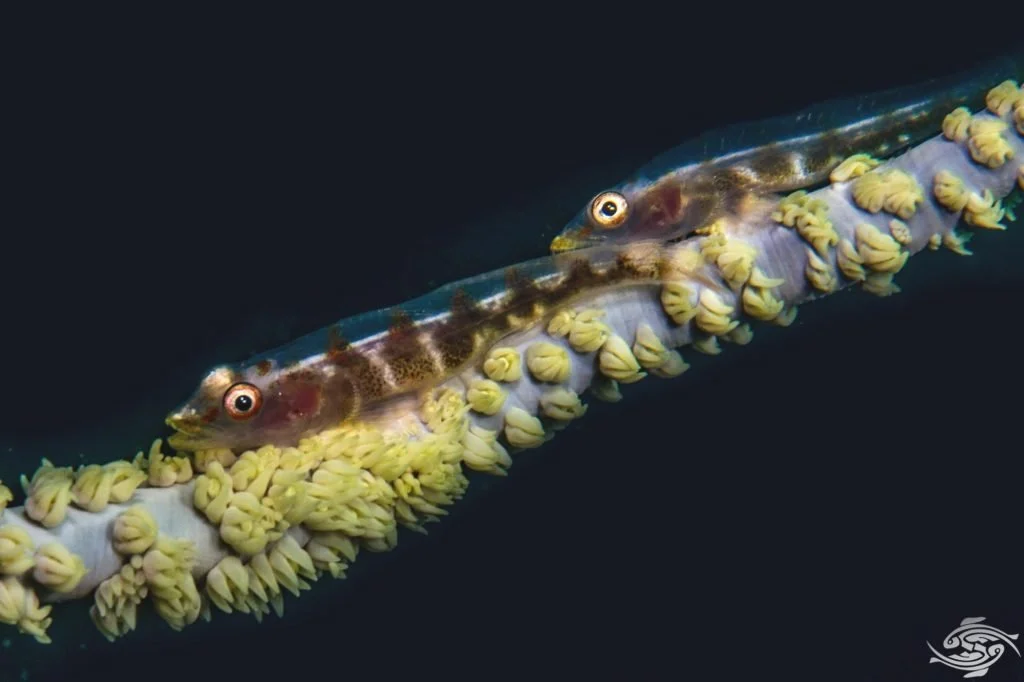
Bryaninops yongei
Photography by: Alan Sutton at www.seaunseen.com
And whip coral gobies are not the only residents!
Anker’s whip coral shrimp (Pontonides ankeri), is just 1.5cm long and incredibly well-camouflaged. They are difficult for predators (and divers alike) to spot! Much like the whip coral goby, they can also be found in pairs and feed on tiny drifting organisms.
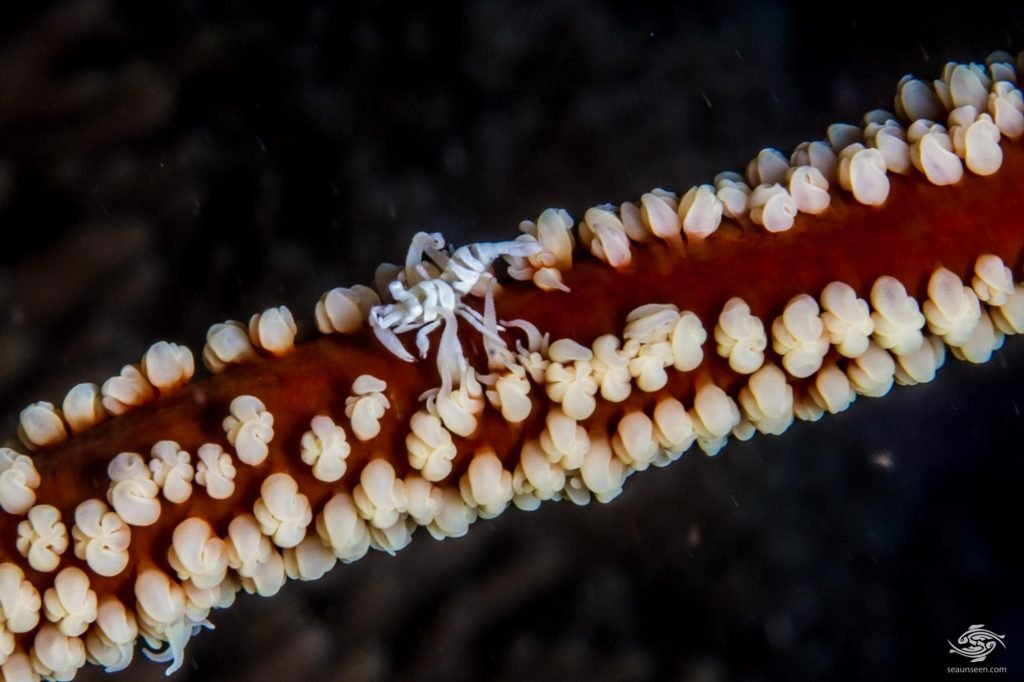
Pontonides ankeri
Photography by: Alan Sutton at www.seaunseen.com
Another thing we know about whip corals (or black corals more generally), is that they face significant threats. They have been harvested for centuries, originally for medicinal purposes. In fact, the name Antipatharia comes from the Greek words anti and pathos, meaning “against disease” or “against suffering”. This reflects a long history of cultural beliefs about their healing properties, from treating eye diseases to relieving pain, reducing fever, stopping bleeding and even remedies for mouth sores and respiratory conditions.
In modern times, commercial harvesting has focussed on jewelry making. The jet-black skeleton of black corals can be polished to a high sheen and has unfortunately led to their overexploitation, particularly during the 1950s and 60s in regions such as Hawaii and the Caribbean.
On top of this, black corals are frequently caught in bottom trawls, leading to further destruction. This is problematic because black corals grow extremely slowly, with some individuals living for centuries or even millennia. Once removed, they can take an incredibly long time to recover.
As a result, all black coral species have been protected since 1981 under Appendix II of the Convention on International Trade of Endangered Species (CITES). This means that international trade is strictly regulated, and many countries have introduced bans or restrictions on harvesting black corals following population declines.
Given their vulnerability and ecological importance, recent research has explored the possibility of restoring black coral populations. Studies have shown that species of whip coral such as Cirrhipathes anguina, can be successfully fragmented and transplanted with high survival rates. This opens the door to including whip corals in reef restoration efforts, something we would love to see more of in the future!
With some luck, these delicate, coiled ‘wires’ of the reef will continue to thrive, quietly shaping ecosystems in ways we are only just beginning to understand.