
Puff, Puff, Pass? The Science Behind Dolphins and Pufferfish
In 2013, young bottlenose dolphins were filmed gently manipulating a pufferfish and passing it between individuals. The dolphins appeared to become unusually calm or mesmerized after nudging the inflated, disoriented fish in the now-famous footage from the BBC documentary Dolphins: Spy in the Pod. This recording led the documentary's zoologist and producer, Rob Pilley, to suggest that they were deliberately exposing themselves to small amounts of the pufferfish's toxin, tetrodotoxin (TTX).
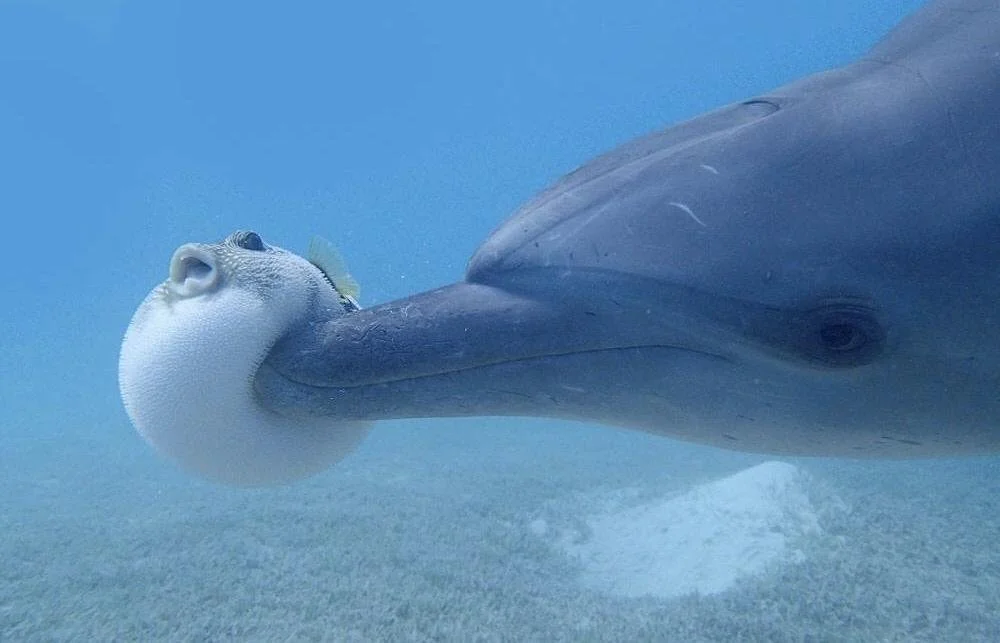
And just like that, one of the internet's favorite animal stories was born: dolphins get high on pufferfish.
But here is the thing: is that actually supported by science?
While documentary filmmaking is a wonderful way to record natural interactions between species, documentaries are ultimately designed to tell a visual story. They provide incredible opportunities to observe animals behaving in their natural environments. However, observing a behavior and explaining why it happens are two very different things. A camera can show us what an animal did, but it cannot tell us what motivated the behavior or what the animal was internally experiencing.
Cetacean Object Play: From Marine Debris to Living Organisms
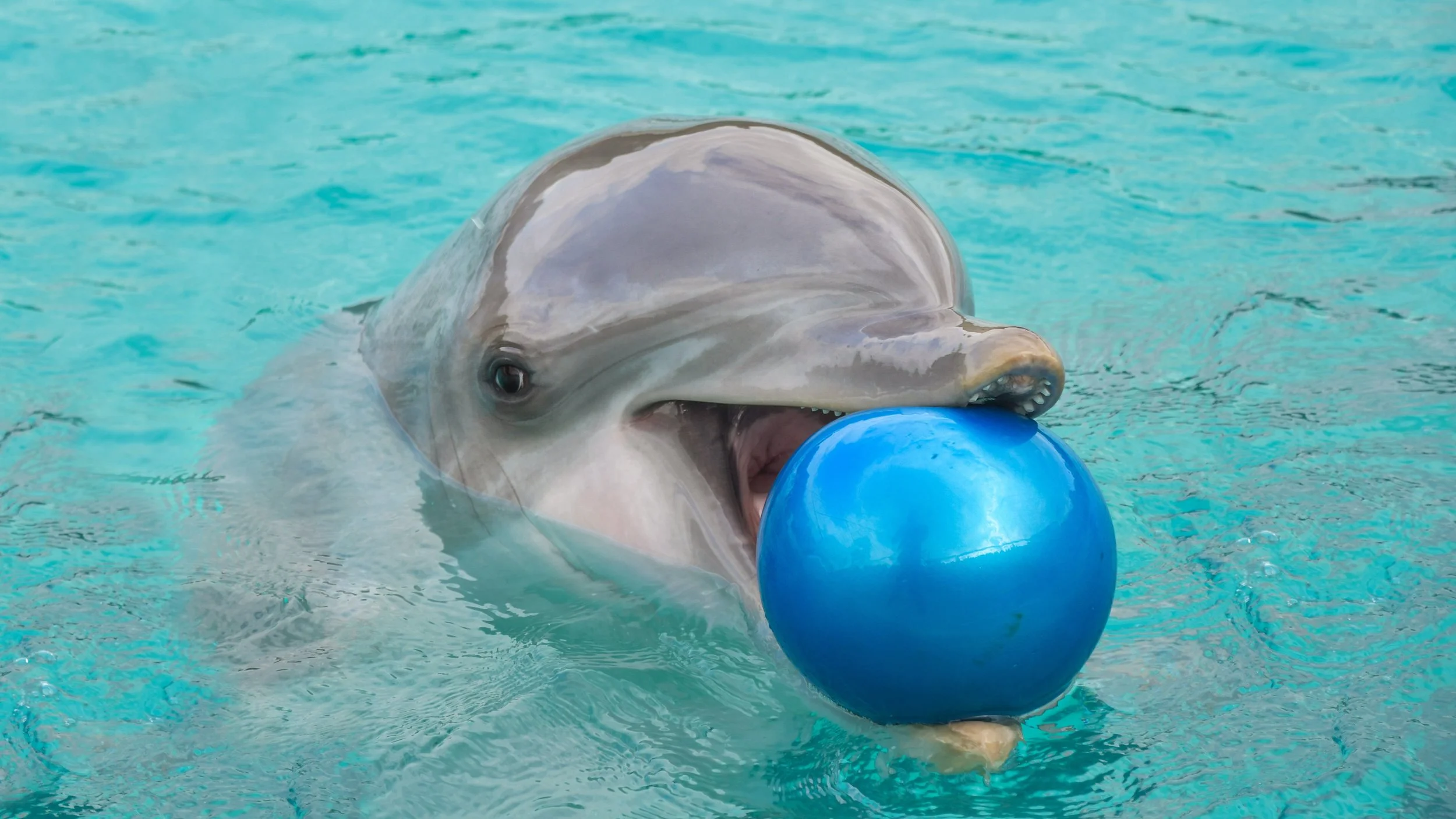
Cetaceans (dolphins, whales, and porpoises) have been documented around the world playing with a surprisingly wide variety of objects, animals, and even seaweed. Dolphins, in particular, are well known for their playful interactions with items in their environment. More recently, researchers have even documented cetaceans interacting with single-use plastics, adding an unexpected, and rather concerning, item to the growing list of things they incorporate into play. The fun, buoyant, ball-like shape of an inflated pufferfish certainly looks appealing to a dolphin. Yet it is not all fun and games. Pufferfish release TTX when stressed, and being tossed around like a ball is more than enough to stress a pufferfish out. In high enough amounts, that secretion can actually be fatal to a dolphin just trying to have some fun.
The Neurobiology of Tetrodotoxin
So, what exactly is tetrodotoxin, and why is it so dangerous?
TTX is a potent neurotoxin found across several marine animals, including pufferfish and blue-ringed octopuses. Interestingly, pufferfish do not synthesize the toxin themselves; it is produced by symbiotic bacteria (such as Pseudoalteromonas and Vibrio) and accumulated through their diet. TTX functions as a sodium channel blocker that disrupts normal neural signaling. Sodium channels are essential proteins in cell membranes that allow for nerve impulses, muscle movement, and respiration. Given that, TTX can be extremely dangerous, even in minuscule quantities. The toxicity is dose-dependent, but in humans, a dose of roughly 2 mg (about the size of a single grain of sand) is enough to cause fatal respiratory arrest.
Crucially, TTX is not psychoactive. It is a large, polar molecule that cannot cross the blood-brain barrier in meaningful quantities, and it has no affinity for dopamine, serotonin, opioid, or cannabinoid receptors. In other words, it possesses no pharmacological mechanism to produce a recreational "high," euphoria, or a trance. If a dolphin absorbs a tiny, sublethal amount through its oral mucosa, the primary sensation is not intoxication, but localized numbness, tingling, and mild motor impairment.
Returning to Dolphins: Spy in the Pod, the footage clearly captured a fascinating moment. But it leaves open the core question: why? Why would dolphins choose to play with an inflatable fish that could possibly cause them so much harm?
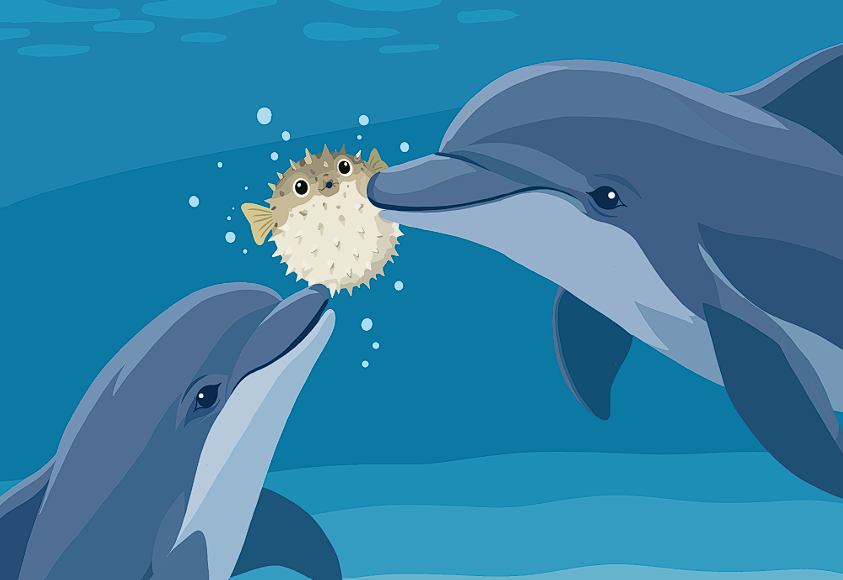
Illustrated by Helena Arenales
To determine what is really driving the interaction, researchers have to ask more rigorous questions:
Do dolphins intentionally seek out TTX?
Do dolphins experience any kind of physiological reward from the interaction?
Do dolphins deliberately regulate the dose of the toxin?
Are their slow movements an actual reaction to the toxin, or simply careful handling of a fragile, prickly animal?
Do dolphins repeatedly seek out pufferfish specifically to experience these effects?
Without controlled studies, scientists cannot use a single piece of documentary footage as evidence of chemical dependency or drug-seeking behavior. Instead, animal behaviorists point to far simpler, well-documented alternatives:
Object play and motor manipulation
Natural curiosity toward novel shapes and textures
Social bonding and coordination within the pod
Sensory exploration of their habitat
Complex behaviors we simply do not fully understand yet
To determine any motivation between having pufferfish as a playtoy, scientists cannot confidently use a single piece of footage as credible evidence of motivation.
So, do dolphins get high on pufferfish?
Neurochemically, probably not. TTX numbs nerve endings; it does not produce euphoria.
What we do know is that dolphins play, dolphins are curious, pufferfish contain TTX, and dolphins have been filmed interacting with them. Everything beyond that is an interpretation.
Until someone figures out how to conduct a controlled experiment with a dolphin, a pufferfish and a very patient ethics committee, the “dolphin drug” story is best left in the interesting hypothesis box and not the scientific fact box.
And honestly?
We think “Dolphins play with weirdly shaped toxic fish” is pretty cool all by itself.